Insertion of a Portacath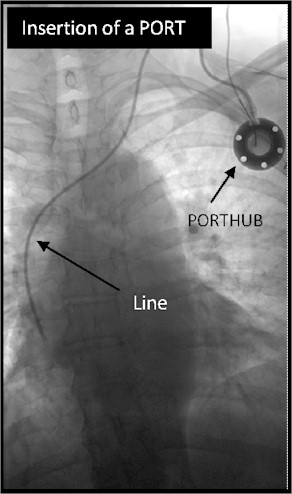
A port consists of a reservoir compartment (the portal) that has a silicone bubble for needle insertion with an attached plastic tube (the catheter). The catheter runs from the portal and is surgically inserted into a vein usually the superior vena cava. Once a port is inserted it can stay in for months or even years if it is cared for properly. A portacath is inserted due to:
Preparation
You will need to fast for four hours prior to your appointment time, this will ensure that your stomach is empty and eliminate the risk of aspiration (of fluid or food into the lungs). Please go to the peri-operative department on the day of your procedure and the staff there will prepare you and perform a set of routine observations before coming to the interventional radiology department for your procedure. Please continue to take all your regular medication with sips of water (unless otherwise instructed), including your blood pressure medication. Please inform the clerk at the time of booking your procedure if you are currently taking medication that thin your blood (eg Aspirin, Plavix, Warfarin) as these may need to be stopped a few days prior to your procedure. It may be useful to bring a LIST of medications to your appointment. You will need to have a blood test a few days prior to your appointment to assess your kidney function and blood clotting times. If your blood sample was taken outside the hospital then please obtain a copy of the results and bring it with you on the day of your procedure. You will need to bring any previous films (x-ray/CT/MRI/US) along to your appointment. It is important that you inform a member of staff as soon as possible if you are pregnant BEFORE the procedure is performed. If you suspect that you could be pregnant then you will need to have a pregnancy test at the hospital prior to the commencement of the procedure. This procedure involves the use of intravenous contrast; see Intravenous Contrast For health and safety reasons, family members cannot be present with you during the procedure. A staff member will be available to assist you at all times during the procedure if you have any concerns. A doctor will explain the procedure beforehand and you will be required to sign a consent form. If you require an interpreter, please inform the booking clerk at the time of booking. Procedure
You will be required change into a hospital gown and lie on our examination table on your back and a set of observations will be taken (blood pressure etc). A sterile sheet will be draped over you with the insertion site exposed. A cold cleaning solution will be applied to clean the skin. The doctor will inject local anaesthetic to numb the area.
Once the catheter is in its place (usually the superior vena cava) a pocket is made in the subcutaneous tissue for the portal. The port is then stitched in place and a clear water proof dressing is applied. The dressing can be removed after five days. You will be given an extra dressing, a small booklet about the port-a-cath and a wallet-sized identification card. This card should be keep with you when you visit your physician, hospital or clinic so that information on the implanted port will be readily available. After the Procedure
You will be required to stay in the department for recovery depending upon the doctor’s discretion to monitor any signs of complications. Regular observations will be performed during this time. It is important to flush your port every four weeks if your port is not being used to keep it working. Results
A report regarding your procedure will be given to you before you leave to give to your referring doctor. It contains information about your procedure and any findings that your doctor should know about. |
 |
Medical Imaging |
|