Insertion of a PICC line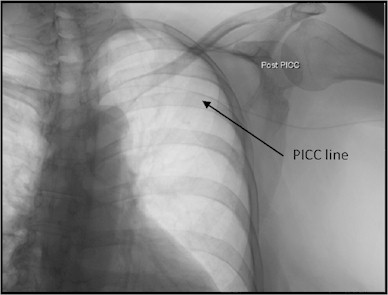
Peripherally inserted central catheters (PICC) are inserted in interventional radiology under fluoroscopy and ultrasound guidance. A PICC line is a long, slender, small, flexible tube that is inserted into a peripheral vein, typically in the upper arm, and advanced until the catheter tip terminates in the superior vena cava (SVC). There are fewer complications with PICC lines and are sometimes preferred over other forms of central venous catheters. A PICC can be inserted by radiologists, physician assistants or certified registered nurses. PICC lines can stay in for months or even years if they are cared for correctly.
Home or sub-acute discharge for extended treatment Preparation
Please continue all regular medications unless instructed otherwise. It is important to inform a member of staff as soon as possible if you are pregnant BEFORE the test is performed. If you suspect you could be pregnant then a pregnancy test will need to be performed prior to the commencement of the examination. For health and safety reasons, family members cannot be present with you during the procedure. A staff member will be available to assist you at all times during the procedure if you have any concerns. You will need to remove any clothes, jewellery or other objects that may interfere with imaging in the area of interest. You will be required to sign a consent form. If you require an interpreter, please inform the booking clerk at the time of booking. Procedure
You will be required to lie on the examination table and a staff member will use ultrasound to visualise and select a suitable vein. A tight band called a tourniquet will be positioned on your upper arm. A needle will be inserted into your vein and a catheter will be advanced along the vein until the tip is positioned into one of the major blood vessels next to the heart. You may be asked to turn your head to one side to help guide the catheter into the right place. You must remain still throughout the whole procedure. A small, clear water proof dressing will be applied on the completion of the procedure to protect the site from infection. A chest x-ray will be performed to confirm the correct placement of the catheter tip. After the Procedure
The dressing should be inspected daily and a clean dressing applied every seven days (once a week). The PICC line will need to be flushed every 12 hours and after each use. Your blood pressure should ideally be performed on the opposite arm to the PICC line. Inspect site for: swelling, redness, leakage or pain. Results
A report regarding your procedure will be given to you before you leave to give to your referring doctor. It contains information about your procedure and any findings that your doctor should know about. Preparation Checklist
Don't forget to bring these along to your appointment
|
 |
Medical Imaging |
|